Baltic Sea
Der goldene HandschuhThe Baltic Sea is a coastal setting that gives the narrative two contrasting forms of possibility: a real place where Karl von Lützow finds comfort in his sister’s company, and a distant destination that Fiete Honka imagines reaching as part of a life he does not yet have.
Setting and Appearances
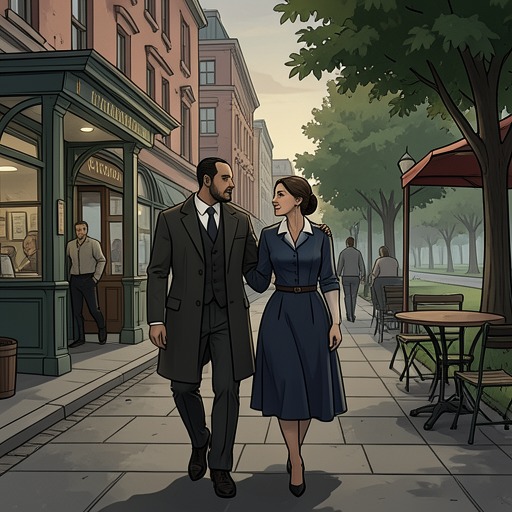
At Laboe, Karl and Margot von Dohren take an extended walk beside the Baltic Sea. They walk silently in step with the waves, and the quiet nearness of his sister brings Karl a sense of connection. The dark thoughts that had risen that morning recede; he stops and embraces her, an impulse he would not have with anyone else. A summer thunderstorm sends them just in time to the Strandklause. Over coffee and cake, they exchange family news, observing an unwritten rule not to speak ill of anyone. The outing thus places the sea beside a smaller, sheltered scene of familial ease: the weather turns, but their companionship remains steady.
Distance and Longing
For Fiete Honka, the Baltic Sea enters through overheard conversation rather than direct experience. At a restaurant in the Hamburg TV Tower, he hears that Timmendorfer Strand on the Baltic coast is less than a hundred kilometres away. The information immediately becomes a measure of what separates him from an ordinary freedom of movement: he wants a car, but believes he will never manage to get a driving licence. The thought expands beyond the coast. Fiete Honka imagines a car alongside steady employment, his own apartment, and a woman. The Baltic Sea is not shown as a destination he reaches; it marks the distance between his present circumstances and a more independent life he can only picture.